Gili Trawangan’s Water Crisis Is Sending Tourists Back to Bali: What Actually Happened
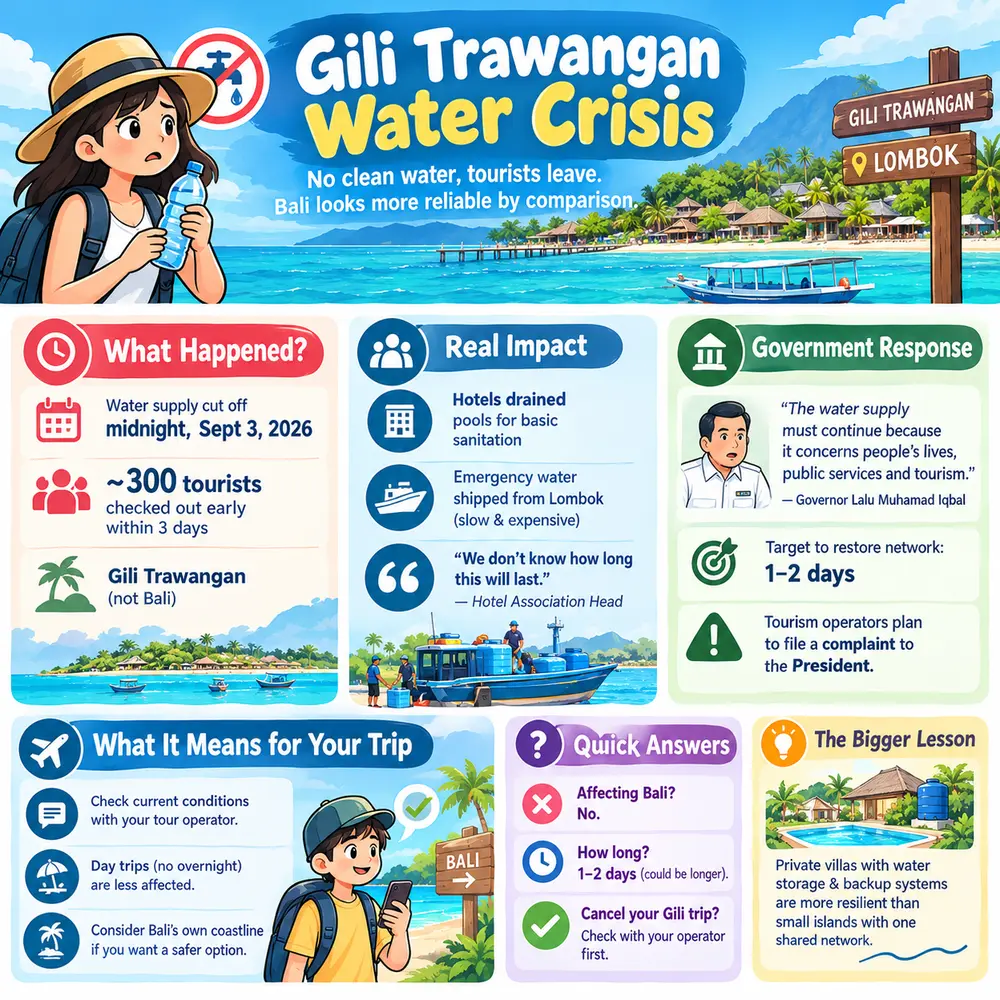
The Gili Trawangan water crisis has done something we don’t often get to report honestly: it’s made Bali look like the more reliable choice by comparison. Clean water on the small Lombok island stopped completely around midnight on Thursday, September 3, 2026, and within days roughly 300 tourists had checked out early rather than wait it out.
The short version: this is happening on Gili Trawangan, off Lombok, not on Bali itself, but if you had a Gili day trip or stay planned as part of a wider Bali holiday, it’s worth knowing the real situation before you commit to it.
What Happened, and When
Gili Trawangan’s clean water supply cut out entirely around midnight on September 3, 2026, in an area that normally sees over 3,000 visitors a day across the three Gili islands during peak season. Within three days, roughly 300 tourists had chosen to check out early rather than continue their stay without reliable running water — a meaningful chunk of the island’s typical guest count for a small stretch of coastline that runs almost entirely on tourism.
The Human and Business Impact
Lalu Kusnawan, who heads the Gili Trawangan Hotel Association as well as IHGMA, put the scale of the problem plainly: “About 300 people have chosen to check out early and leave Gili Trawangan.” Hotels resorted to draining their own swimming pools to keep basic sanitation running for the guests who stayed, and operators began shipping emergency water in by boat from Lombok — a solution that’s both slow and expensive relative to actual demand. Kusnawan didn’t downplay the uncertainty either: “We don’t know how long this situation will last. But if it continues for a week, we don’t know what will happen.”
What Officials Are Saying
West Nusa Tenggara’s provincial government has stepped in directly, with Governor Lalu Muhamad Iqbal visiting neighboring Gili Meno to address the situation in person. His public comments were unusually direct for a government response: “The water supply must continue because it concerns people’s lives, public services and tourism,” and, notably, “We apologise to the community, tourism operators and the tourists who have been affected.” The government’s own target for restoring the network is one to two days, though tourism operators are reportedly preparing a formal complaint to President Prabowo Subianto over the underlying infrastructure gaps that let this happen in the first place.
What This Means If You Were Planning a Gili Day Trip
If a Gili Islands trip was on your Bali itinerary, it’s worth checking current conditions with your tour operator directly before committing to a booking, rather than assuming the standard postcard experience is guaranteed right now. Day trips that don’t involve overnight stays are less exposed to the crisis than multi-night bookings, since you’re not relying on the island’s water system for showers, laundry, or extended sanitation. If you’d rather sidestep the uncertainty entirely, there’s no shortage of alternative day-trip territory closer to a Seminyak base — Bali’s own coastline and hinterland don’t share Gili Trawangan’s water infrastructure at all.
Quick Answers About the Gili Trawangan Water Crisis
Is this affecting Bali itself? No — Gili Trawangan is a separate small island off Lombok, with its own independent water infrastructure. Bali’s own water supply is unaffected.
How long will the water crisis last? Officials have targeted one to two days to restore the network, though the Hotel Association head has been candid that a longer disruption, up to a week or more, isn’t ruled out.
Should I cancel a planned Gili trip? Check directly with your tour operator or accommodation for current conditions rather than cancelling outright — the situation is actively being worked on and may resolve before your travel date.
The Chimera Villas Take
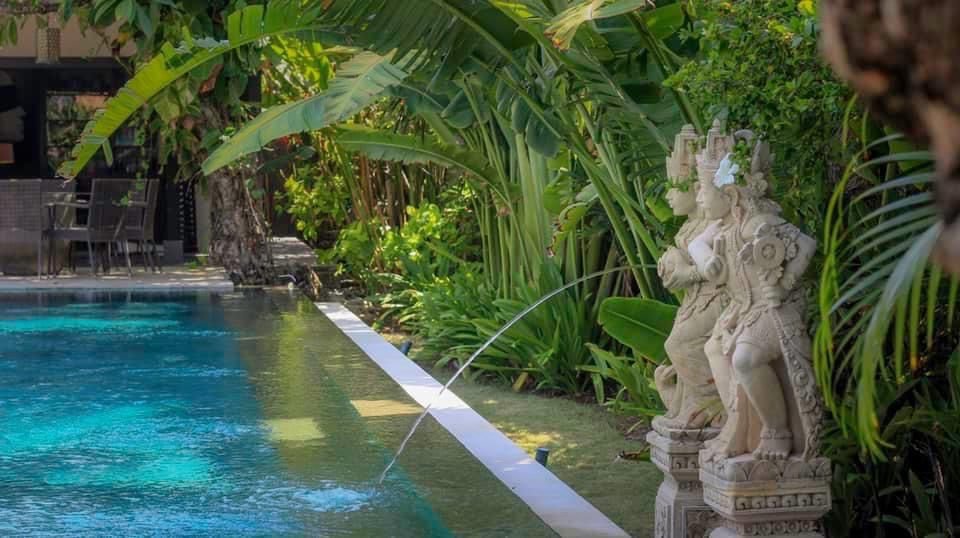
This is a genuinely useful reminder of something worth knowing about small-island tourism generally: infrastructure that works fine at normal volume can fail fast under strain, which is part of why we’ve kept an eye on Bali’s own El Niño drought risk in the island’s drier north. A private villa with its own water storage and backup systems doesn’t carry the same single-point-of-failure risk as a small island running on one shared network — something worth factoring in if a Gili side-trip was ever meant to be the highlight rather than the whole holiday.