
El Niño Watch: What Bali’s 2026 Drought Risk in the North Really Means for Your Villa Stay
Update, October 25, 2026: The El Niño described below has since strengthened. NOAA’s Climate Prediction Center, in its October 8 discussion, has an El Niño Advisory in place and says a strong-to-very-strong El Niño is likely through January to March 2027. BMKG’s drought early warning for the last ten days of October puts Buleleng in its highest tier. We’ve added the details below. The original July text is left as written, so its forecasts, including a 50-60% chance of a weak-to-moderate El Niño and peak dryness in August, reflect what BMKG was saying then.
Bali’s rainy season just wrapped up and the dry months are settling in, which usually means nothing more dramatic than better beach days. This year, meteorologists are watching a second factor layered on top of the normal seasonal switch, and it’s specifically the north of the island that’s being flagged as one to watch.
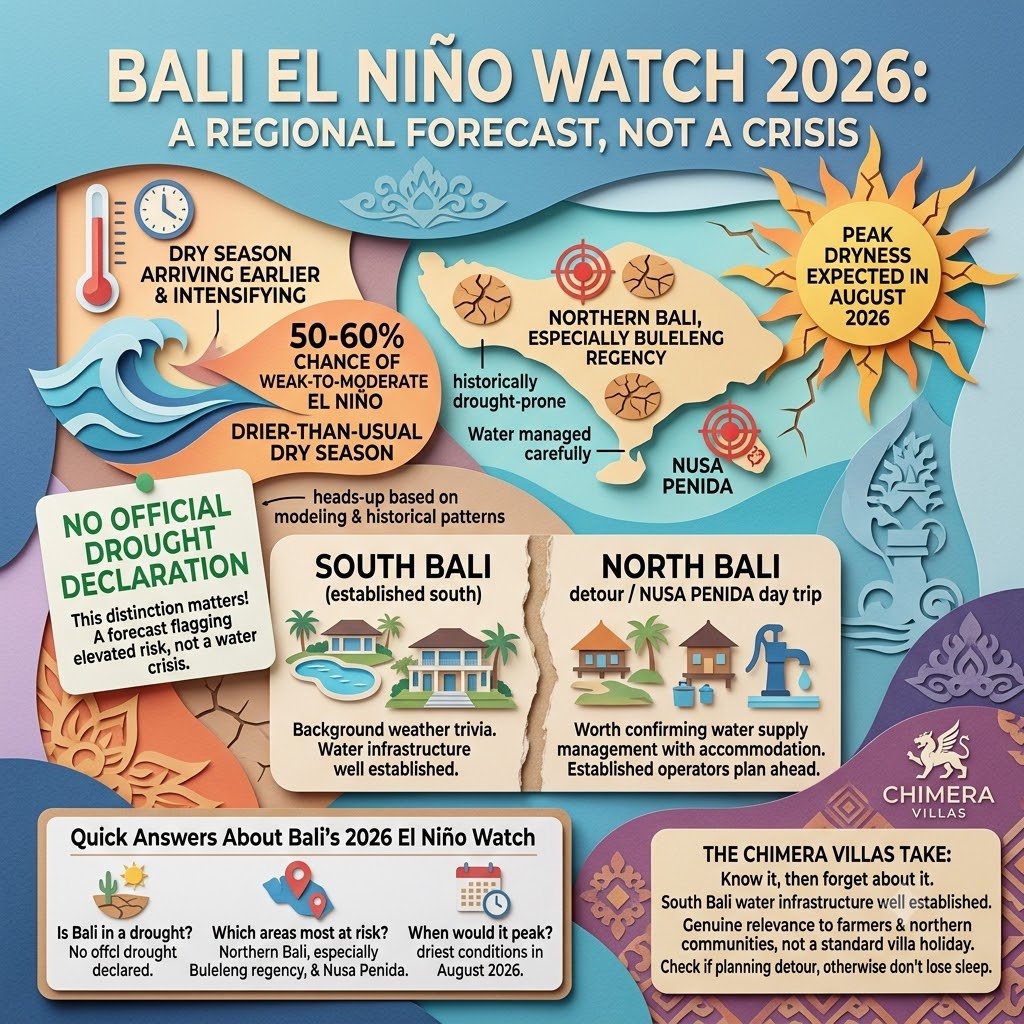
Indonesia’s climate agency, BMKG, has moved its forecast from a neutral ENSO reading to a 50-60% chance of a weak-to-moderate El Niño developing through the second half of 2026, which typically means a drier-than-usual dry season. The dry season itself may also arrive earlier than normal, with peak dryness expected in August, and northern Bali, particularly Buleleng regency, along with Nusa Penida, have been named as the areas most exposed to reduced rainfall.
Short version: no official drought has been declared, this is a forecast, not an emergency, but it’s worth understanding if your travels take you north.
Why the North, Specifically
Buleleng’s coastal areas are historically the most drought-prone part of Bali even in an average year, so layering a possible El Niño pattern on top of an early, intensifying dry season puts that region first in line for any real impact. Nusa Penida, which already manages water more carefully than the mainland, has been flagged for similar reasons.
What “No Official Warning” Actually Means
BMKG has been clear that this is still a seasonal transition period, and it’s too early to formally declare a meteorological drought. That distinction matters: this is a heads-up based on modeling and historical patterns, not a confirmed water crisis. Access to clean drinking water isn’t generally a concern anywhere on the Bali mainland, especially with the island’s broader push toward greener, better-managed resources, water infrastructure simply varies more by region than most visitors realize, and it’s the areas with weaker infrastructure that would feel a moderate rainfall reduction first.
Does This Affect a Villa Stay?
For most visitors staying in the established south, this is background weather trivia rather than a planning concern. If your itinerary includes a few nights in Buleleng or a Nusa Penida day trip during August, it’s worth confirming with your accommodation that water supply is well managed, most established operators there already plan around this seasonal reality every year.
Where Things Stand Now (October 2026)
The El Niño has strengthened well beyond the July forecast. In its October 8 discussion, NOAA’s Climate Prediction Center kept an El Niño Advisory in place and said the event has strengthened further, with a strong-to-very-strong El Niño likely through January to March 2027 and a greater than 83% chance of that. It reported that the Niño-3.4 sea surface temperature anomaly had reached +2.1°C, and that rainfall anomalies remained suppressed over Indonesia. NOAA adds that with an event of this size, impacts consistent with El Niño are more likely but not guaranteed. Its next update is due November 12 (NOAA ENSO discussion).
ANTARA reported on October 23 that BMKG’s head, Teuku Faisal Fathani, had earlier said the Pacific sea surface temperature anomaly hit +2.63 degrees, a very strong El Niño projected to last until early 2027. That figure comes from a different agency and may not measure the same region as NOAA’s, so we haven’t compared the two.
What BMKG’s Early Warning Shows for Bali
BMKG’s meteorological drought early warning for the final ten days of October 2026 rates Buleleng in its highest tier, Awas. Five areas are one step down, in Siaga: Badung, Jembrana, Karangasem, Tabanan and the city of Denpasar. Bangli, Gianyar and Klungkung are in Waspada, the lowest warning tier. We checked the table on BMKG’s website directly (BMKG early-warning page). Nusa Penida isn’t named separately; administratively it falls under Klungkung.
This is an early-warning rating based on rainfall, not a declaration of drought or a water crisis. It does confirm the July article’s flag on Buleleng. It also shows that the warning covers most of the island, including Badung, which takes in Seminyak, Canggu and Uluwatu, and Denpasar, which includes Sanur. What that means for a villa stay isn’t something the table says, and we haven’t found any report of water shortages affecting visitors in the south.
The Rainy Season Is Running Late
On October 23, ANTARA reported that BMKG forecasts a delayed start to the rainy season across most of Indonesia, covering 529 of its seasonal zones, or 61.08% of the country’s land area, with rains arriving gradually from November 2026 in some zones and December in others. The same report quotes an official at the national disaster agency, BNPB, saying it continues to monitor weather data on the potential for prolonged drought, and says Central Java and Yogyakarta endured 131 days without rain. It doesn’t mention Bali. For Bali’s own situation, BMKG’s Bali climatology station, as reported by ANTARA and covered in our earlier article, expects the rainy season to start in November for a small part of the island and in December for most of it; see our report on the delayed rainy season and dry spell.
What We Haven’t Found
We haven’t found an official drought declaration for Bali, or 2026 reports of government water-aid deliveries to Buleleng, Karangasem, Bangli or Nusa Penida, though our search wasn’t exhaustive and local-language coverage may exist that we missed. If your plans include Buleleng or Nusa Penida in the coming weeks, it’s still sensible to ask your accommodation how its water is supplied.
Quick Answers About Bali’s 2026 El Niño Watch
Is Bali in a drought? We haven’t found an official drought declaration for Bali. BMKG’s early warning for late October rates Buleleng at its highest tier, so it’s more than a forecast now, but it is still an early-warning rating, not a declared emergency.
Which areas are most at risk? BMKG’s late-October table puts Buleleng in its highest tier, with Badung, Jembrana, Karangasem, Tabanan and Denpasar one step below. Our July article also flagged Nusa Penida, which the table doesn’t name separately.
When would it peak? BMKG expected the driest conditions in August 2026, as of July. By October, BMKG was forecasting a late start to the rainy season across much of Indonesia, and BMKG’s Bali station, per our earlier report, expects it to start in November for a small part of the island and in December for most of it.
The Chimera Villas Take
South Bali’s water infrastructure is well established, and this is one of those stories that’s genuinely more relevant to farmers and northern communities than to a villa holiday in Seminyak or Canggu. Worth knowing before you plan a Buleleng detour, not worth losing sleep over otherwise.





Pingback: Bali's Rainy Season Is Running Late After a Record 123 Dry Days: What It Means for Your Trip - Chimera Villas Bali
Pingback: Gili Trawangan Water Crisis: What Actually Happened