
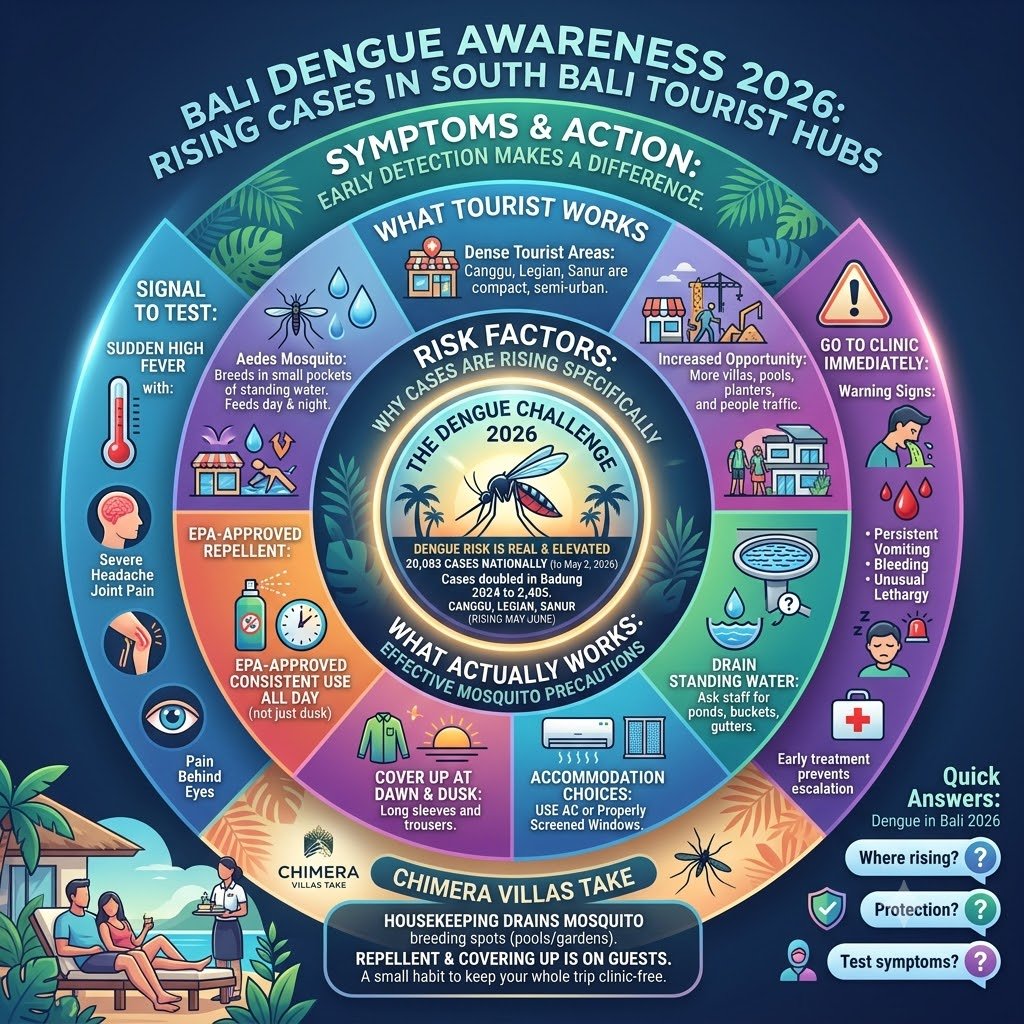
Dengue Season Alert 2026: Simple Precautions to Keep Your Bali Villa Holiday Mosquito-Free
Correction and update, October 25, 2026: When we published this article in July, it said Indonesia had recorded 20,083 dengue cases and 36 deaths, that authorities had reported rises in Canggu, Legian and Sanur, and that Badung cases had reached 2,405 in 2024. We could not find a published source for those claims. The Health Ministry reported 39,672 cases and 105 deaths nationally through May 2026, and the 36 deaths belong to West Java alone. Bali’s health office said in late July that cases were not rising, and none of the sources we found names Canggu, Legian or Sanur. We’ve replaced those passages with figures we’ve checked and added WHO and CDC guidance. The prevention advice is otherwise unchanged.
A mosquito bite is easy to ignore on a tropical holiday, everyone gets a few. But dengue is present in Bali all year, and it’s worth taking a few simple precautions rather than shrugging it off.
Bali’s health office reported 1,588 confirmed dengue cases and two deaths from January to July 2026, and said the cumulative total was down on 2025 (ANTARA Bali, August 11). Nationally, the Health Ministry reported 39,672 cases and 105 deaths through May 2026, with West Java the hardest hit, at more than 9,000 cases and 36 deaths (RRI, June 16).
Short version: dengue is a real but manageable risk in Bali. Cases were not rising as of late July, but the health office says weather can change that, and basic mosquito precautions do most of the work.
Why Standing Water Matters
Dengue spreads through the Aedes mosquito, which breeds in small pockets of standing water. That’s why Bali’s health office keeps repeating the same advice after rain: check buckets, water containers and anything else that can hold water, and clear it. The office names weather as the main driver of rises and falls in cases.
The Precautions That Actually Work
None of the effective prevention here is complicated. Use insect repellent consistently, and not only at dusk: WHO says the mosquitoes that spread dengue are active during the day, and CDC says they bite during the day and night. WHO lists repellents containing DEET, picaridin or IR3535, and CDC advises an EPA-registered product. Wear loose-fitting long sleeves and trousers, and choose accommodation with air conditioning or window and door screens (CDC). If you’re near standing water, ornamental ponds, uncovered buckets, clogged gutters, ask your villa staff to keep it drained, since that’s exactly where mosquitoes breed.
When to Actually Worry
A sudden high fever, especially paired with a severe headache, joint pain, or pain behind the eyes, is the signal to get tested rather than wait it out. Warning signs like persistent vomiting, bleeding, or unusual lethargy mean go to a clinic immediately, dengue can escalate quickly in a small number of cases, and early treatment makes a real difference.
What WHO and CDC Say About Symptoms and Treatment
WHO says symptoms, if they occur, usually begin 4 to 10 days after infection and last 2 to 7 days, and that most people have mild symptoms or none. The most common are high fever, headache, body aches, nausea and rash (WHO dengue fact sheet). CDC says about 1 in 20 people who get sick with dengue go on to develop severe dengue, and that a blood test is the only way to confirm the diagnosis (CDC symptoms page).
The warning signs tend to appear after the fever has gone. CDC says they usually begin 24 to 48 hours after the fever subsides, and include belly pain or tenderness, vomiting at least three times in 24 hours, bleeding from the nose or gums, vomiting blood or blood in the stool, and feeling extremely tired or restless. CDC says to go to a local clinic or emergency room immediately if you notice any of them.
There is no specific treatment for dengue, WHO says, and early detection and proper medical care greatly lower the risk of death from severe dengue. For pain, WHO advises paracetamol (acetaminophen) and says to avoid ibuprofen and aspirin because they can increase the risk of bleeding. CDC also advises watching for dengue symptoms for two weeks after you return from a trip. We aren’t medical advisers, so check with a doctor about anything you’re unsure of.
Where Bali Stands Right Now
Bali’s health office reported 1,588 confirmed dengue cases and two deaths from January to July 2026, one of them a toddler in Buleleng in April, and said the cumulative total was down compared with 2025. Bali’s full-year death total for 2025 was 13 (ANTARA Bali, August 11). On July 28, the same official, I Gusti Ayu Raka Susanti, said cases had not shown an increase and that June and July were lower than earlier months, each below 300 cases (RRI, July 29).
She said the office is intensifying the 3M Plus routine of draining and covering water containers, supporting larva monitoring by community volunteers known as jumantik, using larvicide, and fogging selectively after epidemiological investigation. It also uses a climate-based tracking tool called DBDKlim.
Elsewhere on the island, Gianyar recorded 260 cases from January to April 2026 with no deaths, with the Sukawati area reporting the most (Bali Discovery, June 4, citing Beritabali). For Denpasar, the most recent full-year figure we found is from 2024: 1,309 cases and nine deaths (Bali Discovery, January 2025). We couldn’t find 2026 figures for Badung, Canggu, Legian or Sanur, so we can’t say how those areas compare.
Quick Answers About Dengue in Bali 2026
Are cases rising in Bali? Not as of late July 2026. Bali’s health office said the trend was down and that June and July each had fewer than 300 cases. We couldn’t find figures for Canggu, Legian or Sanur specifically.
How do I protect myself? Repellent, covering up (including during the day), screened or air-conditioned accommodation, and no standing water nearby.
What symptoms mean I should get tested? Sudden high fever with headache or joint pain, especially if it lasts more than a couple of days.
The Chimera Villas Take
It’s worth asking any villa host how standing water around the pool and garden areas is checked, but repellent and covering up, during the day as well as at dawn and dusk, are on you. It’s a small habit for the whole trip, in the same category as keeping a respectful distance from local dogs, in exchange for not spending a single day of it in a clinic.





Pingback: Bali's Rabies Numbers Climb in 2026: A Villa Guest's Guide to Staying Safe Around Local Animals - Chimera Villas Bali