
Bali’s Rabies Numbers Climb in 2026: A Villa Guest’s Guide to Staying Safe Around Local Animals
Update, October 25, 2026: Newer figures are in. Bali’s health office reported 45,365 animal-bite cases and seven rabies deaths for January to August 2026 (ANTARA Bali, August 13). We’ve added those numbers and WHO’s first-aid guidance below, and corrected the wound-washing time to WHO’s 15 minutes. We’ve also removed a vaccine-stock figure (88,599 vials) that we could not re-verify against a published source. The rest of the original article is unchanged.
Bali’s dogs are part of the scenery, snoozing on temple steps, trotting along the beach, guarding warungs like unofficial staff. Most of the time they’re harmless. But 2026 has been a genuinely tough year for rabies on the island, and it’s worth knowing the real numbers before you reach down to pet the next friendly-looking stray.
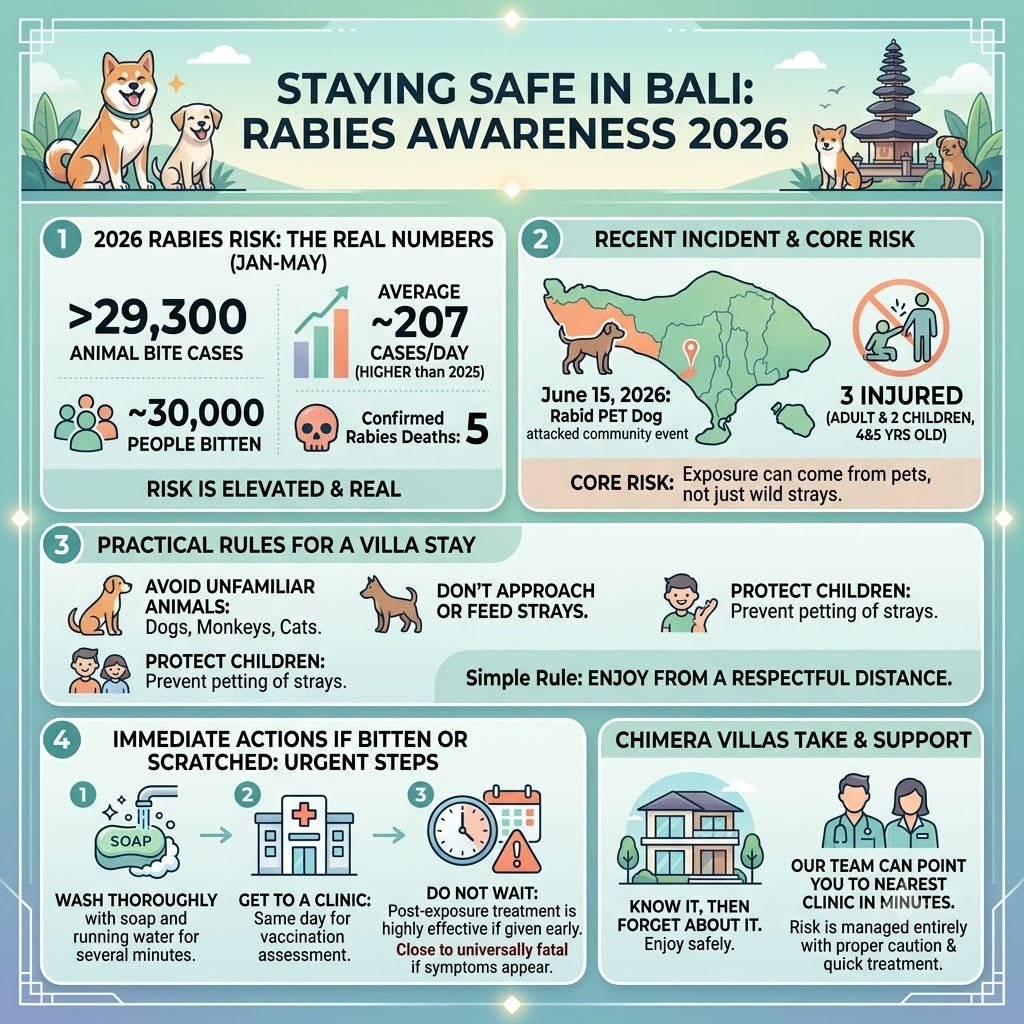
Between January and May 2026, Bali recorded more than 29,300 animal bite cases involving rabies-transmitting animals, averaging around 207 cases every single day. Close to 30,000 people were bitten and roughly 21,000 received emergency vaccinations, while five deaths from rabies have been confirmed through mid-2026. For comparison, all of 2025 saw 66,760 bite cases, averaging about 180 a day, so this year’s pace is already running hot.
Short version: rabies risk in Bali is real and currently elevated, but it’s also entirely manageable if you know to avoid contact with strays and get any bite treated immediately.
A Recent Reminder of Why This Matters
On June 15, 2026, a rabid pet dog attacked residents gathered at a community event in Jembrana regency, injuring three people, a 47-year-old adult and two children aged five and four. It’s a sharp illustration of the core risk: rabies exposure in Bali doesn’t require seeking out a wild animal, it can come from a pet that seemed perfectly normal until it wasn’t.
The Response: Vaccines, But Also Vigilance
Post-exposure treatment is widely available at clinics and hospitals across the island, and in August the Bali Provincial Health Office said stocks of the post-exposure vaccine are sufficient through the end of the year, so this isn’t a situation where treatment is hard to find. The harder part is making sure bites actually get reported and treated quickly, since rabies is close to universally fatal once symptoms appear but highly treatable if you get vaccinated soon after exposure.
What This Means for a Villa Stay
None of this means avoiding dogs entirely, most of Bali’s animals are healthy and uninterested in tourists. The practical rule is simple: don’t approach or feed unfamiliar dogs, monkeys, or cats, keep children from petting strays no matter how friendly they look, and if you are bitten or even scratched, treat it as urgent. Wash the wound thoroughly with soap and water for at least 15 minutes, as the World Health Organization advises, and get to a clinic the same day for a vaccination assessment, don’t wait to see if symptoms appear.
The Latest Figures, January to August
Bali’s health office told ANTARA that Bali recorded 45,365 bite cases from rabies-carrying animals between January and August 2026, with seven deaths (ANTARA Bali, August 13). The earlier figure in this article, more than 29,300 bites for January to May, was reported by The Star and the Jakarta Post in June. If both counts use the same definition, which the reports don’t confirm, that is roughly 16,000 more bites in the three months since. That subtraction is ours, not an official figure.
The death toll has risen too: five had been reported as of late June, and seven by August. The health office’s disease-control head, I Gusti Ayu Raka Susanti, said that, on average, the people who died hadn’t reported their bites to a health facility, so staff didn’t know they had been bitten.
For context on 2025, parliament member Firman Soebagyo cited 66,760 bite cases for last year during a September visit to Denpasar’s veterinary centre, and said 16 people in Bali died from rabies among them (RRI, September 22). The Star also puts 2025 rabies deaths in Bali at 16, and says official data show Bali had the highest dog population in Indonesia, at 565,737. The RRI report describes Bali as being under a rabies emergency, but that is the lawmaker’s framing, and the ANTARA and Star reports we read don’t mention a formal declaration.
What Officials Say to Do After a Bite
The World Health Organization says anyone bitten should immediately wash the wound with water and soap for at least 15 minutes and seek medical attention, and that rabies deaths are preventable with prompt post-exposure treatment. It also says that once symptoms appear, rabies is fatal in virtually all cases (WHO rabies fact sheet, dated September 17, 2026). The US CDC gives the same 15-minute wound-washing advice and notes that rabies in dogs is still common in many countries outside the United States.
In Bali, the health office’s message on August 11 was to go to a health facility straight away after a bite, not to wait. Staff then decide what is needed. As the office explained it, a bite from a healthy pet dog with proof of vaccination and no rabies signs is treated as safe, while a bite from a stray or unmonitored dog gets the anti-rabies vaccine immediately. The office says vaccine stocks are sufficient through the end of the year, but it still allocates the vaccine by risk because of its cost, and says 33,930 bite victims who met the criteria have received it so far.
For a visitor, our reading of that is simple: a bite or scratch from any dog, cat or monkey you can’t vouch for is a reason to see a clinic the same day. That is our interpretation of the guidance, not medical advice.
It Isn’t Only Dogs
It’s easy to think of rabies as a dog problem, but The Star’s report on the Jembrana attack also describes a 38-year-old woman in the same regency who died on May 24 after a stray cat bit her calf about a month earlier. According to the report, she didn’t seek treatment and washed the wound herself. The same report says the dog in the June 15 attack died the next day, that laboratory tests on its brain tissue confirmed rabies, and that the three victims received post-exposure vaccination.
Before You Travel
WHO says pre-exposure vaccination might be indicated before recreation or travel in some areas, but that it doesn’t replace the need for treatment after a bite. CDC’s advice for travelers is to avoid wild animals and to find out whether rabies is present in dogs or wildlife at your destination. If you’re travelling with young children who are likely to approach animals, it may be worth asking a travel clinic about it before you go. We aren’t medical advisers, so please treat that as a prompt for a conversation, not a recommendation.
Quick Answers About Bali’s 2026 Rabies Situation
How bad is it this year? Bali’s health office reports 45,365 bite cases from January to August 2026, after more than 29,300 were reported for January to May.
What happened in Jembrana? A rabid pet dog injured three people, including two young children, on June 15, 2026.
What should I do if I’m bitten? Wash the wound immediately with soap and water for at least 15 minutes and get to a clinic the same day for treatment, don’t wait.
How many people have died of rabies in Bali this year? Seven from January to August 2026, according to Bali’s health office, up from five reported in June.
How long should I wash a bite? At least 15 minutes with soap and water, according to WHO and CDC, then seek medical care.
Do I need the vaccine after every bite? That’s for a clinician to decide. Bali’s health office says it assesses each case by the risk of the animal involved.
The Chimera Villas Take
This is a “know it, then forget about it” kind of risk, much like dengue precautions elsewhere on the island. Enjoy the beach dogs from a respectful distance, keep kids from feeding strays, and if anything ever does break the skin, treat it as a same-day errand, not something to sleep on. A good habit on any stay is to ask your host on arrival where the nearest clinic is, so you already know if you ever need it, and that’s most of the risk managed.





Pingback: Seminyak Restaurant Fire: What We Actually Know
Pingback: Dengue Season Alert 2026: Simple Precautions to Keep Your Bali Villa Holiday Mosquito-Free - Chimera Villas Bali