Anak Krakatau Just Erupted, and Bali Flights Are Being Cancelled: What You Need to Know
The Anak Krakatau eruption early Sunday morning has done exactly what volcanic ash always does to air travel in this part of the world: grounded planes, rerouted flights, and left travelers scrambling to check their status. If you’ve got a Bali trip booked in the next few days, here’s the actual, verified picture rather than the panic version circulating online.
The short version: Anak Krakatau erupted for 30 seconds at 3:53am on Sunday, September 6, 2026, sending ash toward Java and Sumatra, and by Sunday afternoon Bali’s Ngurah Rai Airport had recorded 42 flight cancellations or schedule changes — serious, but a fraction of the nationwide disruption, and not a reason to assume your own trip is affected without checking directly.
What Actually Happened
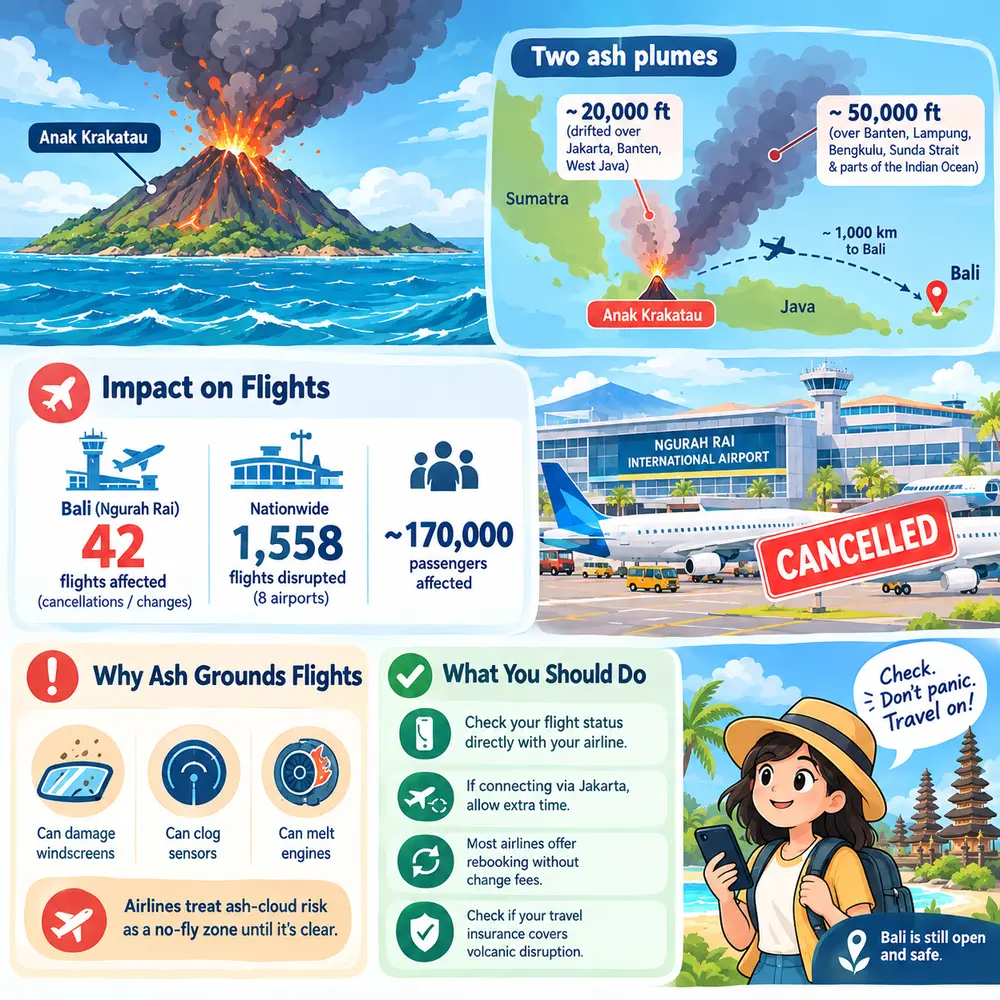
Anak Krakatau sits in the Sunda Strait, the stretch of water between Java and Sumatra, roughly 1,000 kilometers from Bali by air. Indonesia’s Geological Agency had noted rising activity from Friday before the volcano erupted just before 4am on Sunday. Two separate ash plumes resulted: one rose to about 20,000 feet and drifted northeast over Jakarta, Banten, and West Java, while a second, larger plume reached roughly 50,000 feet and spread over Banten, Lampung, Bengkulu, the southern Sunda Strait, and parts of the Indian Ocean west of Sumatra.
The Impact on Bali Specifically
Bali’s own airport wasn’t at the center of the ash cloud, but flight paths and connecting routes were. By Sunday afternoon, Ngurah Rai Airport management had logged 42 flights affected by cancellations or schedule adjustments, with five Jakarta-to-Bali flights cancelled by 10am alone, including services operated by TransNusa and Indonesia AirAsia. Nationwide, the numbers were far larger: roughly 1,558 flights delayed or cancelled across eight airports, affecting an estimated 170,000 passengers. Jakarta’s Soekarno-Hatta International Airport, over 150 kilometers from the volcano, extended its own closure until nearly 9am the following morning.
Why Volcanic Ash Grounds Flights At All
It’s a fair question if you’ve never dealt with this before: why cancel flights over an eruption a thousand kilometers away? Volcanic ash isn’t like smoke — it’s made of fine, abrasive rock and glass particles that can sandblast a windscreen, clog sensors, and, most seriously, melt inside a jet engine and cause it to fail mid-flight. Airlines and aviation authorities treat any credible ash-cloud risk as a hard no-fly zone until it’s confirmed clear, which is exactly why cancellations can ripple out to airports far from the actual eruption.
A Volcano With a Notable History
Anak Krakatau translates to “Child of Krakatau,” and the name isn’t incidental — it grew out of the caldera left behind by Krakatoa’s catastrophic 1883 eruption, one of the most destructive volcanic events in recorded history. The island has been intermittently active for decades since, including a major eruption and partial collapse in December 2018 that triggered a deadly tsunami around the Sunda Strait. Sunday’s eruption was far smaller and, unlike 2018, produced an ash-and-disruption event rather than a tsunami risk, but the volcano’s track record is part of why Indonesian authorities react quickly and conservatively whenever it shows renewed activity.
What To Do If You’re Flying Through Bali This Week
Check your specific flight’s status directly with your airline rather than assuming the worst from headlines — ash clouds move and disperse, and disruption at 8am doesn’t necessarily mean disruption at 8pm. If you’re connecting through Jakarta specifically, build in extra buffer time, since that airport absorbed a larger share of the nationwide disruption than Bali did. Most airlines are offering rebooking without change fees for eruption-related cancellations, so it’s worth asking directly rather than assuming you’ll be charged. And if you haven’t already, check whether your travel insurance covers volcanic disruption specifically — some policies treat it separately from generic flight delay cover.
Quick Answers About the Anak Krakatau Eruption
Is Bali itself in danger from the eruption? No — Anak Krakatau is roughly 1,000 kilometers from Bali, and the disruption has been to flight paths and connections, not any direct threat to the island.
How many Bali flights were cancelled? Bali’s Ngurah Rai Airport recorded 42 flights affected by cancellations or schedule changes as of Sunday afternoon, September 6.
Should I cancel my upcoming Bali trip? Based on what’s confirmed so far, no — check your specific flight status, but this reads as a disruption event, not a reason to cancel a trip outright.
The Chimera Villas Take
Ash-cloud disruptions like this one tend to resolve within days rather than weeks once the eruption itself settles, much like the Flores earthquake back in August turned out to be a real event with limited practical impact on Bali travel itself. If your flight is affected, your airline is the fastest source of truth — not social media. And if volcanoes have you curious rather than worried, Bali has its own, considerably calmer one worth knowing about: we’ve covered what it actually takes to climb Mount Agung for anyone planning ahead.