Hantavirus in Indonesia: Why Bali Still Has Zero Cases, and What That Actually Means
Every so often a health story surfaces with a name unfamiliar enough to sound alarming, and travellers with trips booked start googling at midnight. Hantavirus has been that story in Indonesia this year. So here is the straightforward version, including the part that tends to get lost.
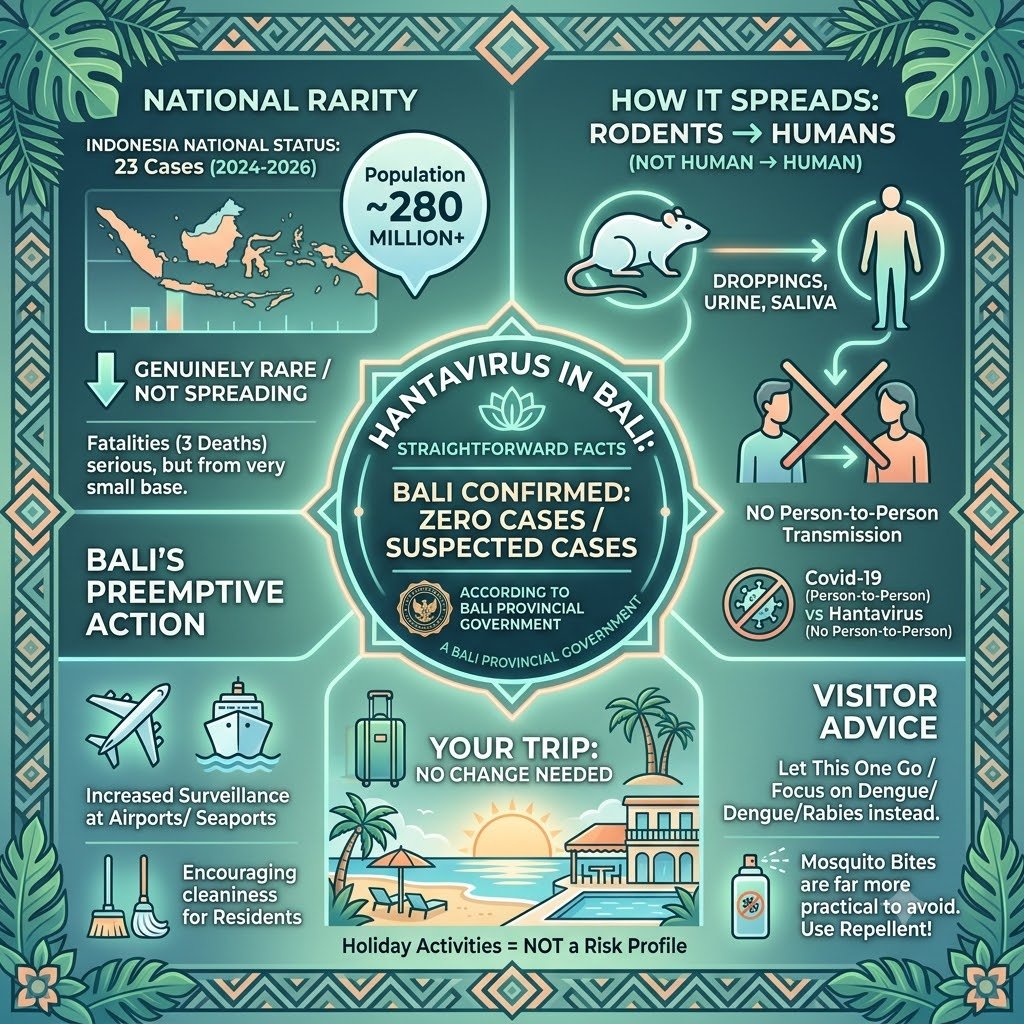
Bali has recorded no cases. Not one, and no suspected cases either, according to the Bali Provincial Government.
Short version: hantavirus exists in Indonesia at very small numbers, it has not appeared in Bali, it does not spread between people, and the precautions have nothing to do with normal holiday activity.
The Actual Numbers
Indonesia’s Ministry of Health has recorded 23 hantavirus cases nationally across a three-year span from 2024 to 2026. Of those, three people died, giving a case fatality rate of about 13 percent.
That fatality rate is the figure that makes headlines, and it deserves context rather than dismissal. Thirteen percent of a very small number is still a serious illness worth taking seriously. But 23 cases across three years, in a country of more than 280 million people, describes something genuinely rare rather than something spreading.
How It Spreads, and Why That Matters
Hantavirus is a zoonotic disease, meaning it moves from animals to humans. It is carried by rodents, primarily rats, and transmitted through direct contact with the droppings, urine or saliva of an infected animal.
The critical detail: unlike COVID-19, it does not transmit between humans. There is no chain of person-to-person infection. That single fact changes the entire risk profile, because it means the virus cannot move through a crowd, an airport, a restaurant, or a hotel.
The situations health authorities actually flag are specific: cleaning buildings that have sat unused for long periods, and working in warehouses or similar spaces where rodents have been undisturbed. That is an occupational risk profile, not a tourism one.
What Bali Is Doing Anyway
Despite having no cases, Bali has increased surveillance at airports and seaports, and in higher-risk work environments. The Bali Health Office has also asked residents to keep homes and surrounding areas clean so rat populations do not establish themselves, and to take care when opening up long-closed buildings.
Acting before a problem arrives rather than after it does is generally the sign of a health system paying attention. It is the same posture Bali has taken with dengue during the wet season and with rabies and animal contact, both of which are considerably more relevant to the average visitor than this is.
Should It Change Your Plans?
No. There is nothing here that warrants altering a trip, buying anything special, or worrying on the flight over. If you want to spend your attention budget on Bali health topics, mosquito bites are the far more practical thing to think about.
Quick Answers About Hantavirus and Bali
Are there hantavirus cases in Bali? No. The Bali Provincial Government has confirmed no cases and no suspected cases to date.
How many cases has Indonesia had? 23 nationally between 2024 and 2026, with three deaths.
Can it spread between people? No. It is transmitted from rodents to humans, not human to human.
What precautions apply to travellers? Essentially none beyond normal hygiene. The flagged risks involve cleaning long-unused buildings and warehouse work, not holiday activity.
The Chimera Villas Take
We would rather give you the boring, accurate version than let a scary word sit unanswered. Zero cases in Bali, no person-to-person spread, and a risk profile that has nothing to do with a pool, a beach or a restaurant. Enjoy the trip, use mosquito repellent in the evenings, and let this one go.