Bali’s Mandatory Waste Sorting Law Takes Effect July 1: What It Means for Villa Guests
Picture this. You’ve just finished a plate of perfectly spicy nasi goreng by your private pool. Beside you sits an empty glass Bintang bottle, a crumpled paper napkin, and a half-squeezed lime.
Before 2026, you might have tossed it all into a single wicker bin under the sink and headed back to your sun lounger. Not anymore.
Starting July 1, 2026, the long-anticipated Bali waste sorting law officially takes effect. Mandated by the local government and the Ministry of Environment, this island-wide regulation targets households, restaurants, and yes—every single hotel and private villa on the island.
If you’re packing your bags for a tropical getaway this summer, you might be wondering if you’re suddenly expected to become a sanitation expert on your holiday. Don’t panic. The new rules are incredibly straightforward, and they are exactly what the Island of the Gods needs to stay beautiful.
Here is exactly what this new eco-rule means for your upcoming stay.
Why the Sudden Change? (And Why It’s Actually Great)
For years, Bali has wrestled with a very unglamorous behind-the-scenes problem: trash.
If you’ve driven down the Ngurah Rai Bypass toward Sanur, you might have unknowingly passed TPA Suwung. For decades, this 32-hectare landfill absorbed the brunt of the island’s waste—taking in upwards of 1,200 tons of unsorted garbage every single day. It was unsustainable. Organizations like Sungai Watch have been doing phenomenal work cleaning up the waterways, but the government knew a systemic fix was required at the source.
The new Bali waste sorting law is that fix.
By forcing businesses and residents to separate organics from plastics and paper at the point of disposal, the island can finally process waste through specialized recycling facilities and composting hubs instead of dumping it in a mountain. It’s a massive win for the beaches you love to surf and the rice terraces you love to photograph.
How This Actually Affects Your Villa Stay
Let’s be honest. You are on vacation. You came to Bali to sip cold coconuts, listen to the cicadas, and let your stress melt away. The good news? Complying with the Bali waste sorting law won’t ruin your zen.
If you rent a licensed, professionally managed property, the management handles the heavy lifting. Your job is just the first step.
The New Bin System Explained
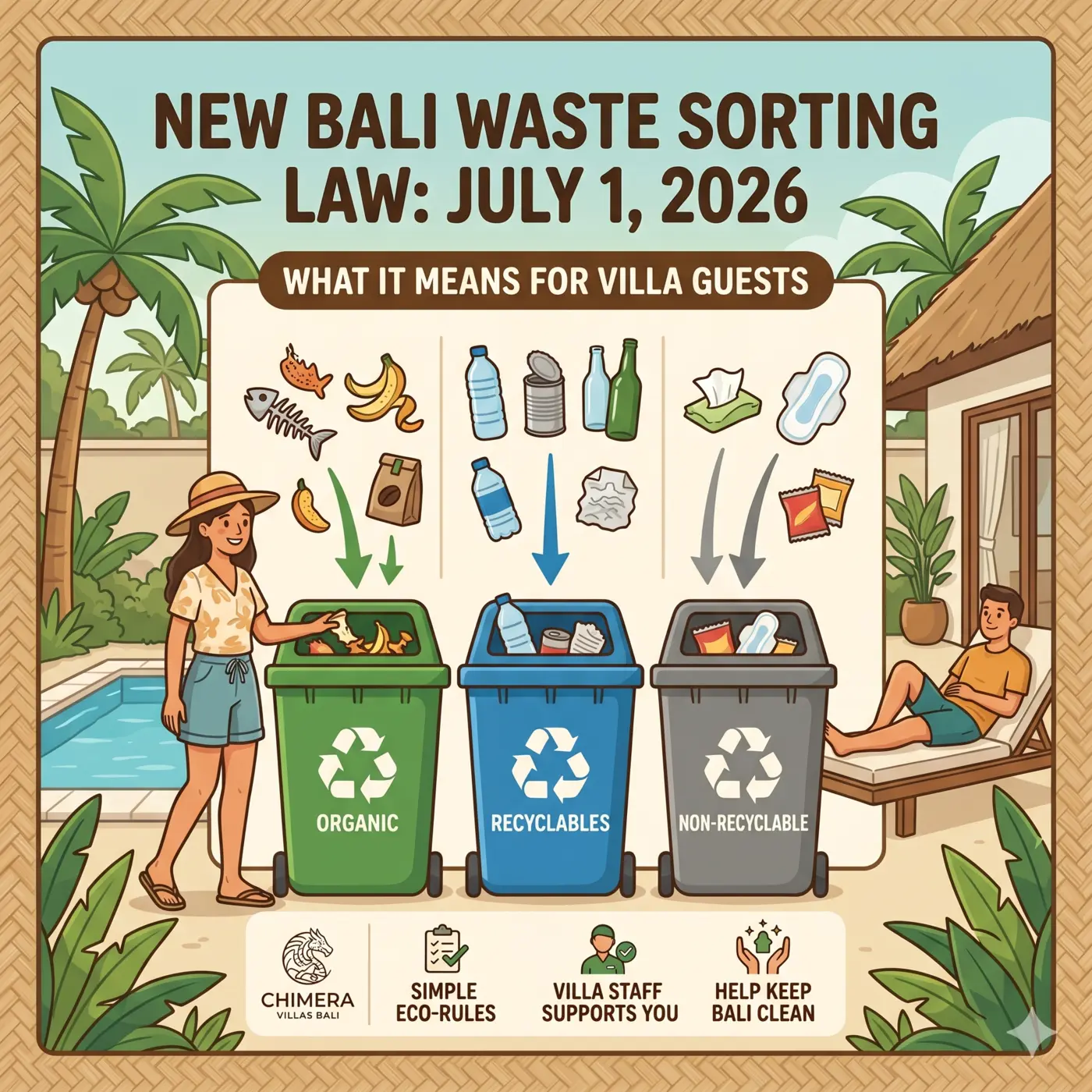
When you check into your villa after July 1, you won’t just see one lonely trash can in the kitchen. You’ll be greeted by a sleek, color-coded system. While exact designs vary by property, the universal separation rules look like this:
- Green Bins (Organic): This is for your leftover fruit peels, coffee grounds, and the remnants of that takeout Mie Goreng. This goes straight to local composting facilities to feed Bali’s rich volcanic soil.
- Yellow or Blue Bins (Recyclables): Toss your empty plastic water bottles, glass soda bottles, aluminum cans, and clean cardboard here.
- Red or Black Bins (Residual/Other): This is for the stuff that can’t be recycled or composted. Think used tissues, sanitary products, and heavily grease-stained wrappers.
What Happens to the Trash Now?
Imagine finishing a coconut. You drop the heavy green shell into the organic bin. The next morning, your villa housekeeper takes it to a centralized village collection point. From there, it bypasses the landfill entirely and is turned into agricultural compost for local farmers. That quick, two-second choice you made in your kitchen directly helps grow the next season’s mangoes.
Answering Your Biggest Questions (The Fine Print)
Whenever new travel rules drop, rumors fly. Let’s clear up a few common questions we’ve been hearing from incoming guests.
Will I get fined if I put plastic in the organic bin?
As a guest inside a private villa, no, the sanitation police aren’t going to knock on your bedroom door. The government holds the property owner responsible for what leaves the villa gates. However, if guests refuse to sort, the villa staff has to dig through the trash by hand to fix it before the garbage trucks will accept it. Sorting your own trash is simply good island etiquette.
Do I need to wash my recyclables?
You don’t need to break out the dish soap and scrub your empty bottles. But a quick water rinse of a sticky soda can before tossing it in the recycling bin keeps ants out of your villa and makes the recycling process much smoother.
Does this apply to street food and beach clubs?
Yes. You will notice new multi-bin stations popping up at beach clubs in Seminyak, cafes in Ubud, and even near night markets. Keep an eye out for the signs before you toss your skewer sticks.
Effortless Luxury Meets Responsible Travel
At Chimera Villas, we believe luxury and sustainability aren’t opposites—they belong together.
We’ve spent the last few months quietly upgrading our properties to seamlessly integrate with the new Bali waste sorting law. When you stay with us, you’ll find beautifully designed, clearly labeled bins that blend right into the villa’s aesthetic. Our trained housekeeping staff handles the final daily sorting, ensuring everything is perfectly prepped for the island’s new eco-facilities.
You get to enjoy a pristine, private sanctuary, knowing that your footprint on the island is lighter than ever.
Bali is evolving. The island is getting greener, cleaner, and more conscious of its future. And by making a tiny shift in how you throw away an empty bottle, you get to be a part of that change.
Ready to experience a greener, more beautiful Bali? Browse our available villas and let us host your perfect dry-season escape.