Bali’s Villa Licensing Push Is Still Reshaping What You’ll Find on Airbnb
Bali’s push to bring every villa listed on booking platforms into tax and licensing compliance is still actively reshaping what shows up when you search for a stay — and as of mid-September 2026, it’s worth understanding where things actually stand rather than relying on outdated headlines. This isn’t a single event so much as an ongoing process, and getting the timeline right matters if you’re deciding where to book.
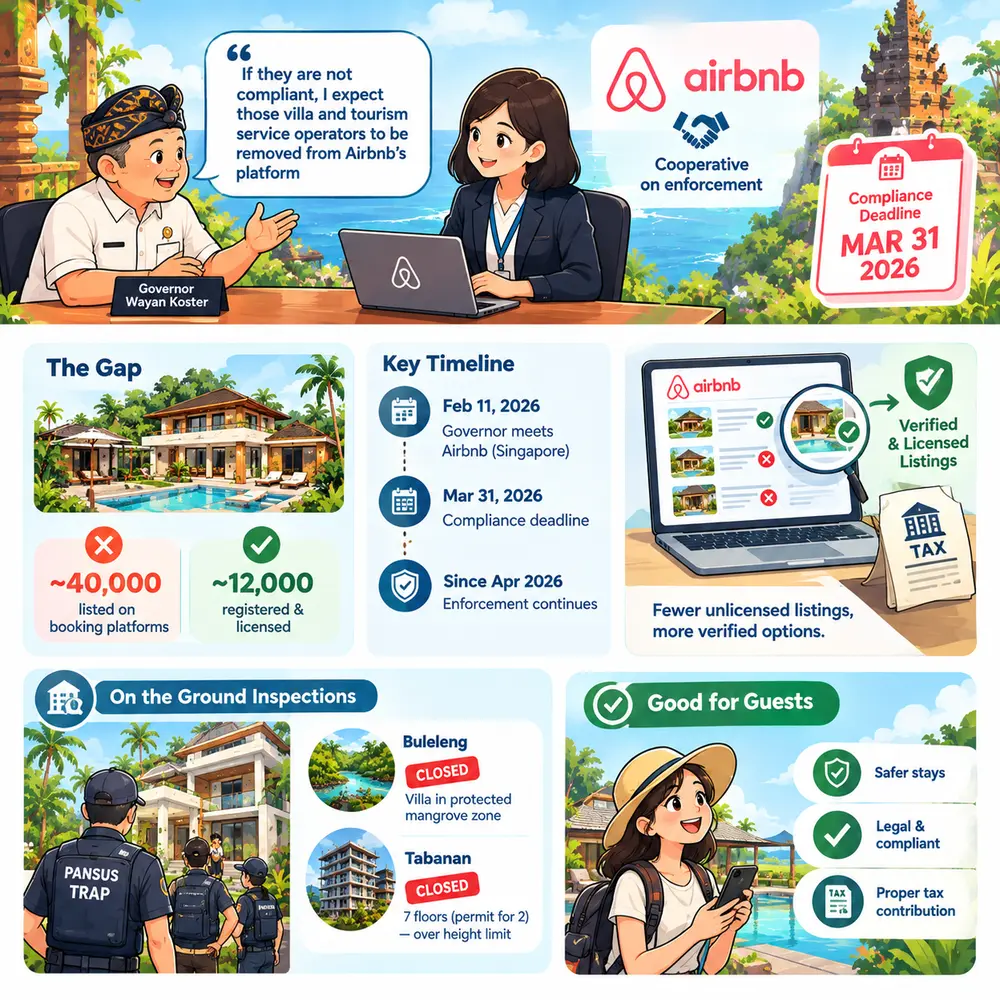
The short version: Bali’s provincial government pressed Airbnb directly to remove non-compliant villas from its platform, tied to a March 31, 2026 compliance deadline, and enforcement against the gap between licensed villas in Bali and unregistered ones has continued through the year since.
What Actually Started This
The pressure traces back to a February 11, 2026 meeting between Bali Governor Wayan Koster and Airbnb’s Southeast Asia policy team, based out of Singapore. Koster’s position was direct: “If they are not compliant, I expect those villa and tourism service operators to be removed from Airbnb’s platform.” Airbnb’s response, according to the same reporting, was cooperative rather than resistant — the platform indicated it took the licensing requirements seriously and was willing to work with the government on enforcement.
The Scale of the Gap Between Listed and Registered
The reason this became a provincial priority rather than a routine compliance memo is the size of the mismatch: authorities have pointed to an estimated 40,000 short-term rental listings across booking platforms in Bali, against roughly 12,000 properties that are actually registered and licensed. That’s a gap of tens of thousands of listings operating in some form of regulatory grey zone — not necessarily unsafe or badly run, but not carrying the paperwork (a Business Identification Number and Tax ID, specifically) that lets authorities verify tax compliance and safety standards.
What Changed for Bookings After the Deadline
Since the March 31 deadline passed, the practical effect for anyone searching Bali accommodation on Airbnb has been a narrower, more verified pool of listings: properties without a valid operating permit or tax registration have been facing removal rather than simply a warning. Booking data is also reportedly now being shared with local tax authorities as part of tracking the Foreign Tourist Levy, which is a meaningfully different level of oversight than existed even a year ago. None of this is finished — enforcement against the remaining unregistered majority is still described as ongoing through 2026, not a one-time cleanup that’s already wrapped up.
Quick Answers About Bali’s Villa Licensing Push
Is this a brand-new crackdown as of September 2026? No — it stems from a February 2026 government meeting with Airbnb and a March 31, 2026 compliance deadline. What’s “new” in September is simply that enforcement is still actively running, not a fresh announcement.
Does this mean fewer villa options in Bali? It means fewer unlicensed listings showing up in search, not fewer legitimate options — licensed, compliant villas are unaffected by the removals.
How can I tell if a villa I’m booking is properly licensed? Ask directly, or book through an operator that’s transparent about its permit and tax status rather than relying solely on a platform listing’s badge.
The Chimera Villas Take
We’ve watched this story develop since it first surfaced with 1,600 villas facing delisting back in August, and the throughline hasn’t changed: Bali’s tightening the gap between what’s advertised and what’s actually licensed, which is a genuinely good thing for guests even when the enforcement process itself is slow and unglamorous. It’s part of why we treat proper licensing as table stakes rather than a selling point — it’s simply what a villa stay in Bali should come with by default.
Enforcement Isn’t Limited to Airbnb Delistings
The pressure on unlicensed villas hasn’t been confined to online marketplaces, either. Bali’s regional legislature runs its own enforcement arm, a special committee known as Pansus TRAP (spatial planning and regional assets), which has been running surprise inspections across Badung, Gianyar, and Buleleng regencies since October 2025. Those inspections have led to real closures on the ground, not just delistings: in Buleleng, the committee shut down villas including Plataran Menjangan for operating inside a protected mangrove conservation zone, and in Tabanan it sealed a villa project that had built seven floors against a permit for two, well past the island’s 15-meter height limit. Whatever happens on Airbnb’s search results, in other words, is running in parallel with physical inspections of the buildings themselves — this is a compliance push happening on two fronts at once, not just a platform-level cleanup.