Alas Kedaton: The Bali Monkey Forest Almost Nobody Talks About
Alas Kedaton Monkey Forest is the kind of place that makes you wonder why nobody told you about it sooner. While buses queue outside Ubud’s Monkey Forest and everyone jostles for the same photo of a macaque perched on a stone wall, this twelve-hectare pocket of forest in Tabanan sits quietly a short drive away, doing its own thing, with barely anyone watching.
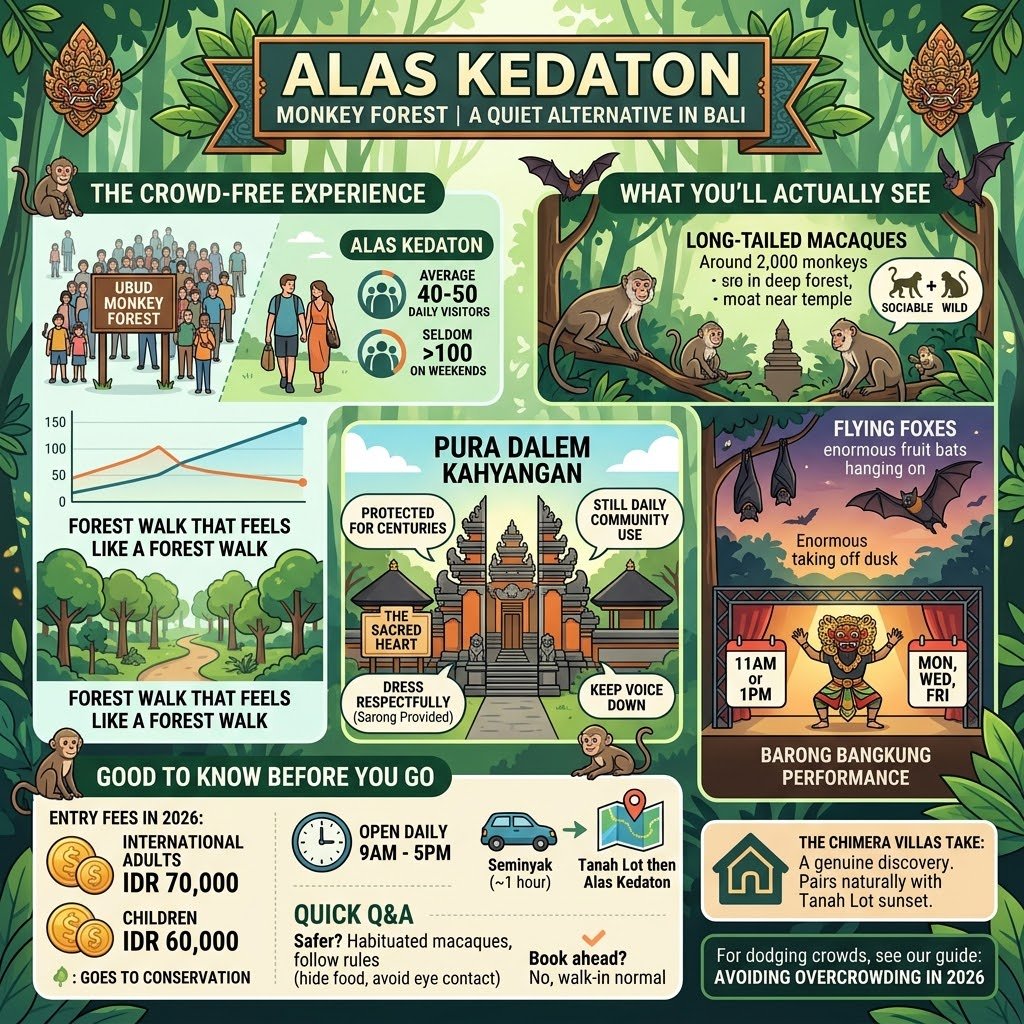
If you want the short version: it’s a genuinely crowd-free alternative to Bali’s famous monkey sanctuaries, home to around 2,000 long-tailed macaques and a colony of fruit bats, wrapped around a temple that’s still very much in daily use by the local community.
Why It Stays So Quiet
Alas Kedaton averages just 40 to 50 visitors a day. Even on a busy weekend, that number rarely climbs past 100 — figures that would barely register at Ubud’s more famous forest before lunchtime. Part of the reason is location: it sits in Kukuh Village, a few minutes from Tanah Lot but not directly on the route most day-trippers take. Part of it is simply that fewer people know it exists. Either way, the result is a forest walk that actually feels like a forest walk, not a queue.
What You’ll Actually See
The macaques here split their time between the deep forest, where many never bother coming out at all, and the areas closer to the temple, where the more sociable ones have grown used to visitors. Come toward dusk and you’ll catch the resident flying foxes stirring — genuinely enormous fruit bats that hang from the canopy by day and take off in loose formation as the light drops. Time your visit for a Monday, Wednesday, or Friday and you can also catch the Barong Bangkung performance at 11am or 1pm, a masked dance rarely seen outside temple ceremonies.
The Temple at Its Heart
Pura Dalem Kahyangan sits at the center of the forest, and it isn’t a backdrop — it’s the reason the forest exists at all. Kukuh Village has protected this land for centuries as a sacred site, and that stewardship is exactly why it’s stayed so untouched. Dress respectfully (a sarong is usually provided at entry), keep your voice down near the temple, and remember you’re a guest in a place that means something to the people who live here.
Good to Know Before You Go
Entry prices rose earlier in 2026 — international adults now pay around IDR 70,000, up from IDR 30,000, with children at roughly IDR 60,000. It’s still inexpensive by most standards, and the fee goes toward the community-run conservation work that keeps the forest intact. The site is open daily from 9am to 5pm, and a local guide is usually on hand if you want more than a self-guided wander.
Getting there is easiest with a driver for the day — Tanah Lot, Alas Kedaton, and a stop at one of Tabanan’s rice terrace viewpoints make a full, unhurried afternoon without doubling back on yourself.
Quick Answers About Alas Kedaton Monkey Forest
Is Alas Kedaton safer than Ubud’s Monkey Forest? Both forests house habituated macaques that can be food-aggressive, so the same rules apply everywhere: don’t carry visible food, avoid direct eye contact, and keep sunglasses and loose jewelry out of reach.
How far is it from Seminyak? Roughly an hour’s drive, similar to the trip out to Tanah Lot, which makes it easy to combine both into one afternoon.
Do I need to book ahead? No — it’s low-traffic enough that walk-in entry is normal, even on weekends.
The Chimera Villas Take
We like recommending Alas Kedaton to guests who’ve already done the obvious Bali checklist and want something that still feels like a discovery. It pairs naturally with a Tanah Lot sunset run, and if you’re drawn to Tabanan’s quieter corners in general, this is a good place to start. For more on dodging the crowds elsewhere on the island, our guide on avoiding overcrowding in 2026 has a few more ideas worth bookmarking.