Is Bali Building Too Many Rooms? A Hotel Chief and a Consultant Weigh In
Two voices from Bali’s hotel industry are asking the same uncomfortable question from different angles: has the island built more rooms than it can fill? The debate over Bali room oversupply sharpened on October 7, 2026, when a hotel association chief warned of a price war, and it follows a consultant’s more detailed look a few weeks earlier.
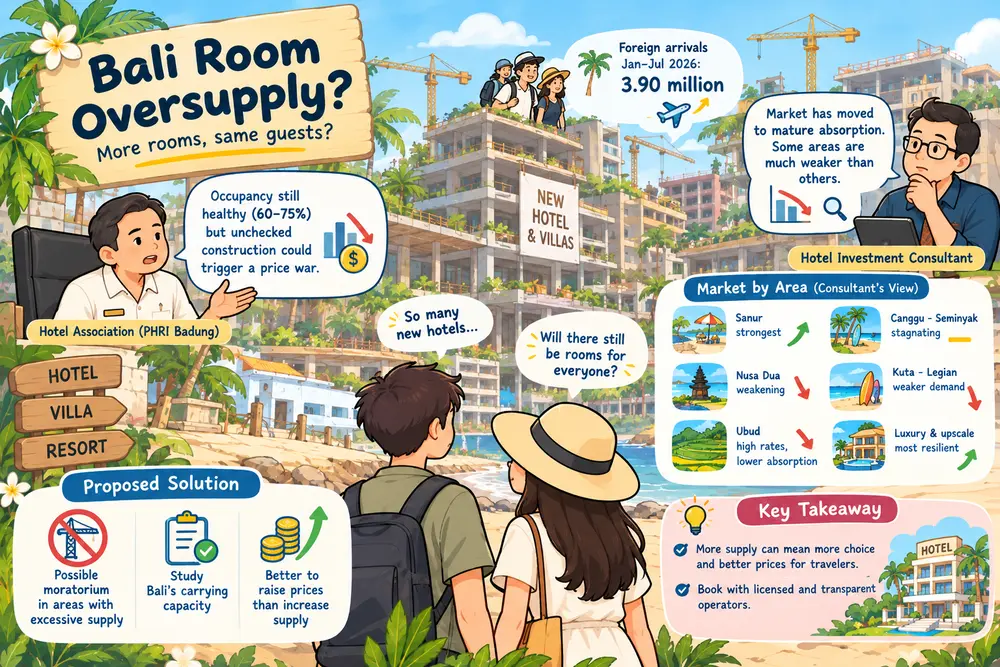
The short version: the head of the Badung chapter of the hotel association says occupancy is still healthy but unchecked construction could trigger a price war, and he wants a pause where supply is excessive. A hotel investment consultant says the market has moved from recovery to what he calls mature absorption, and that some areas are much weaker than others. Neither report gives total room counts or rate data, so the picture is incomplete.
The Hotel Association View
Bali Discovery, citing NusaBali, reported on October 7 the comments of I Gusti Agung Rai Suryawijaya, chairman of the Badung chapter of PHRI, the Indonesian Hotel and Restaurant Association, made on September 30. He said it’s true that many villas are for sale, and noted that most of the hotels on the market are running at occupancy above 60 percent, some reaching 75 percent, which he considers healthy.
His concern is the direction of travel. “It will trigger a price war,” he said of unchecked accommodation growth, adding that in his view it is better to raise prices than to increase supply. He called for a study of Bali’s carrying capacity, a three-to-five-year evaluation and restructuring process, and a possible moratorium in areas where supply is already excessive, singling out Sarbagita (Denpasar, Badung, Gianyar and Tabanan). He said new accommodation should only be opened up selectively again once regional occupancy reaches 90 percent.
He also raised legality, saying properties on land with problematic zoning or missing permits are being marketed on Airbnb and other online travel agencies, and urged regulatory fixes so they can obtain business registration and pay tax.
The Numbers He Cited
He pointed to BPS figures showing 3.90 million foreign visits in January to July 2026, with 697,809 in July alone, up 15.34 percent on June. For the first half of the year, arrivals were down 2.42 percent on the same period in 2025, from 3.28 million to 3.20 million. He estimated foreign arrivals at around 22,000 a day, a figure close to the 20,000 to 24,000 the governor gave in our September 24 article, though no period is given. He also expects domestic visits in September to fall by about 15 percent, citing high airfares, fewer government meetings and the national economy, but the report gives no baseline for that estimate.
The Consultant View
A few weeks earlier, Bali Discovery, citing Kompas, reported the analysis of Ross Woods of PT Hotel Investment Advisory, interviewed on August 24. HIA projects 6.93 million foreign arrivals for 2026, slightly down 0.2 percent on 2025, and counts 2,460 new hotel rooms under construction across Bali, including 688 in Jimbaran-Pecatu-Ungasan scheduled for completion through 2028.
Woods described a market that has moved from recovery to mature absorption, with big differences by area. Sanur looks strongest. Canggu-Seminyak has seen revenue per available room stagnate, with rate increases held back by falling occupancy. Nusa Dua is weakening, Kuta and Legian show a marked drop in demand, and Ubud has high rates but sharply lower room absorption, with more high-end supply coming through 2027. Luxury and upscale properties are the most resilient, but branded hotels in those segments face the heaviest new supply over the next 24 months, while mid-range and economy absorption is weakening. He called positive rate growth in some areas an illusion of recovery.
Reading the Gaps Honestly
It’s worth being careful with the headline claim. The October 7 article calls oversupply undeniable, yet the only occupancy data in it, 60 to 75 percent, is described by its own source as healthy, so the case rests on a warning about unchecked construction rather than on a count of empty rooms. Neither article gives total island room numbers, current room rates, or how many properties are listed for sale. The consultant’s article also doesn’t give per-area occupancy figures, and some of its statistics have no stated period.
There’s also a difference of tone between sources. Governor Koster said in September that hotels are completely full, while the hotel association, in a figure reported by The Bali Sun, put average occupancy at 68 percent in mid-September. Both can be true, because averages hide a lot of variation between areas and hotel types.
Quick Answers About Bali Room Oversupply
Is there a hotel price war in Bali? Not according to these reports. The association chairman warns one could be triggered if supply keeps growing unchecked.
Is Bali planning a moratorium? The chairman has proposed one for areas with excessive supply, but the reports describe a proposal, not a decision.
Which areas look weakest? The consultant points to Kuta-Legian and the outer areas, with Nusa Dua weakening and Canggu-Seminyak stagnating, while Sanur looks strongest.
The Chimera Villas Take
For guests, more supply can mean more choice and sharper prices, but it also makes it harder to tell a well-run property from a poorly documented one. That’s why transparency matters, a theme we’ve followed in our look at Bali’s villa licensing push. Whatever happens with supply, the best protection for a traveler is the same: book with operators who are open about their licensing and easy to reach.