Bali’s 2026 Drone Rules Explained: What Every Traveler Needs to Know Before Flying
If a drone is coming with you to Bali this year, it’s worth ten minutes of homework before you pack it, because the rules changed in ways that catch a lot of well-meaning travelers off guard. This isn’t a “drones are banned” story. It’s a “drones are fine if you actually register the thing” story, and the details matter.
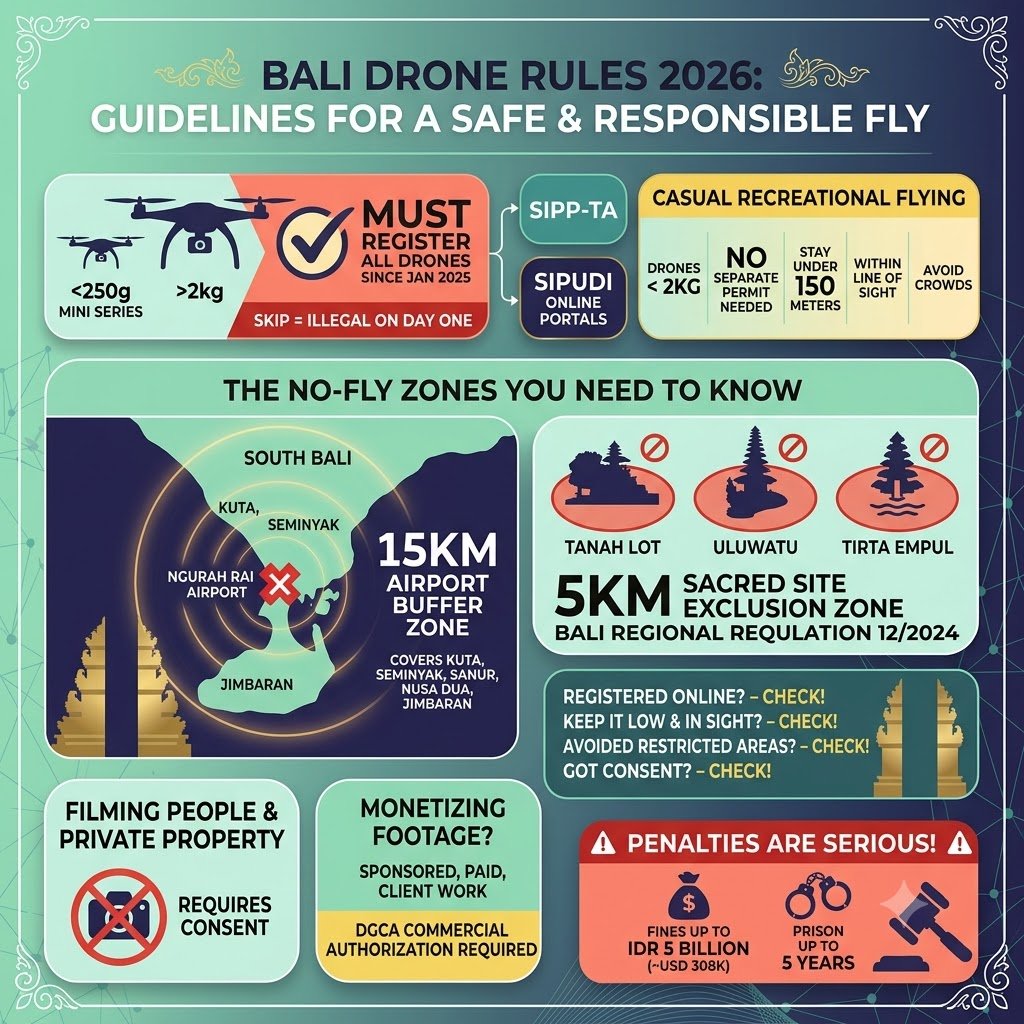
Since January 2025, every drone entering Indonesia, including sub-250g models like the DJI Mini series that people assume are too small to count, must be pre-registered through the SIPP-TA or SIPUDI online portals before you fly. Skip that step and you’re flying illegally on day one, regardless of how careful you are once you’re in the air.
Short version: register your drone online before you travel, keep it under 2kg and under 150 meters for casual recreational flying, and stay well clear of airports and temples, and you’ll be fine. Skip the registration or ignore the no-fly zones, and the penalties get serious fast.
Registration Isn’t Optional, Even for Tiny Drones
The part that surprises the most people is that weight doesn’t exempt you from registering. A featherweight travel drone still needs to go through SIPP-TA or SIPUDI before it ever leaves the ground in Indonesia. It’s a straightforward online process, but it has to happen before you fly, not after a police officer asks to see your paperwork on a beach.
What “Casual Recreational Flying” Actually Allows
Once registered, drones under 2kg used for recreational, non-commercial purposes don’t need a separate flight permit, provided you keep it simple: fly within your own line of sight, stay under 150 meters altitude, and avoid flying directly over crowds or religious sites. That covers the overwhelming majority of travelers just wanting sunset footage over a villa pool or a rice terrace.
The No-Fly Zones You Actually Need to Know
There’s a 15-kilometer no-fly buffer around Ngurah Rai International Airport, and because of how South Bali is laid out, that single restriction quietly covers Kuta, Seminyak, Sanur, Nusa Dua, and Jimbaran. If your villa is in any of those areas, check your exact distance from the airport before you launch, because “I’m nowhere near the runway” doesn’t always hold up on a map.
Separately, under Bali Regional Regulation No. 12/2024, there’s a 5-kilometer exclusion zone around sacred sites, which pulls in some of the island’s most photogenic and most photographed locations: Uluwatu, Tanah Lot, and Tirta Empul among them. These are two different rules stacking on top of each other, airport distance and sacred-site distance, so a spot can be off-limits for either reason even if it looks clear on the other count.
Filming People and Private Property
Beyond the airspace rules, Indonesian law doesn’t allow filming identifiable people or private property from a drone without their consent, which is worth remembering before you fly over someone’s villa garden for a nice establishing shot. And if the footage is headed anywhere commercial, a sponsored reel, a paid shoot, client work, you’ll need separate authorization from the Directorate General of Civil Aviation (DGCA) before monetizing it.
What Happens If You Get It Wrong
The penalties for flying in restricted airspace aren’t symbolic. Violations can carry fines up to IDR 5 billion, roughly USD 308,000, and up to five years imprisonment. That’s a steep price for a mistake that’s entirely avoidable with a bit of pre-trip registration and a quick map check on exclusion zones.
Worth pairing with a look at Bali’s 2026 visa rules for creators and remote workers, since drone footage and content creation trips tend to go hand in hand, and both come with more paperwork than they used to. It’s the same “know before you go” spirit behind Bali’s expanded tourist safety efforts elsewhere on the island.
Quick Answers About Bali’s 2026 Drone Rules
Do I need to register my drone even if it’s small? Yes. Every drone, including sub-250g models, must be pre-registered through SIPP-TA or SIPUDI before flying in Indonesia, a requirement in place since January 2025.
Do I need a permit to fly recreationally? Not beyond registration, as long as your drone is under 2kg, you stay within line of sight, under 150 meters altitude, and away from crowds and religious sites.
Where exactly can’t I fly? Within 15km of Ngurah Rai Airport (covering Kuta, Seminyak, Sanur, Nusa Dua, and Jimbaran) and within 5km of sacred sites like Uluwatu, Tanah Lot, and Tirta Empul.
What if I want to sell or sponsor the footage? You’ll need separate commercial authorization from the DGCA before monetizing any drone footage shot in Indonesia.
The Chimera Villas Take
Register before you fly, plan your shot list around the exclusion zones rather than discovering them mid-trip, and you’ll get the footage without the headache. It’s a fifteen-minute admin task that saves you from a genuinely serious legal problem later, well worth doing from your villa’s WiFi before the drone ever leaves its case.