A Tourist Died at Kelingking Beach: What Every Nusa Penida Visitor Should Know
A 29-year-old Australian tourist from Queensland died on Saturday, September 12, 2026, after falling roughly 80 meters from the cliffside at Kelingking Beach in Nusa Penida — one of the most photographed viewpoints in the Bali area, and a reminder worth taking seriously if it’s on your itinerary.
The short version: she got stuck on the cliff face after leaving the marked path, tried to find her own way down rather than wait for help, and fell during that attempt. This is a genuinely tragic outcome from a spot that draws enormous numbers of visitors every day, most of whom never come close to this kind of risk — but it’s worth understanding exactly what went wrong.
What We Know About What Happened
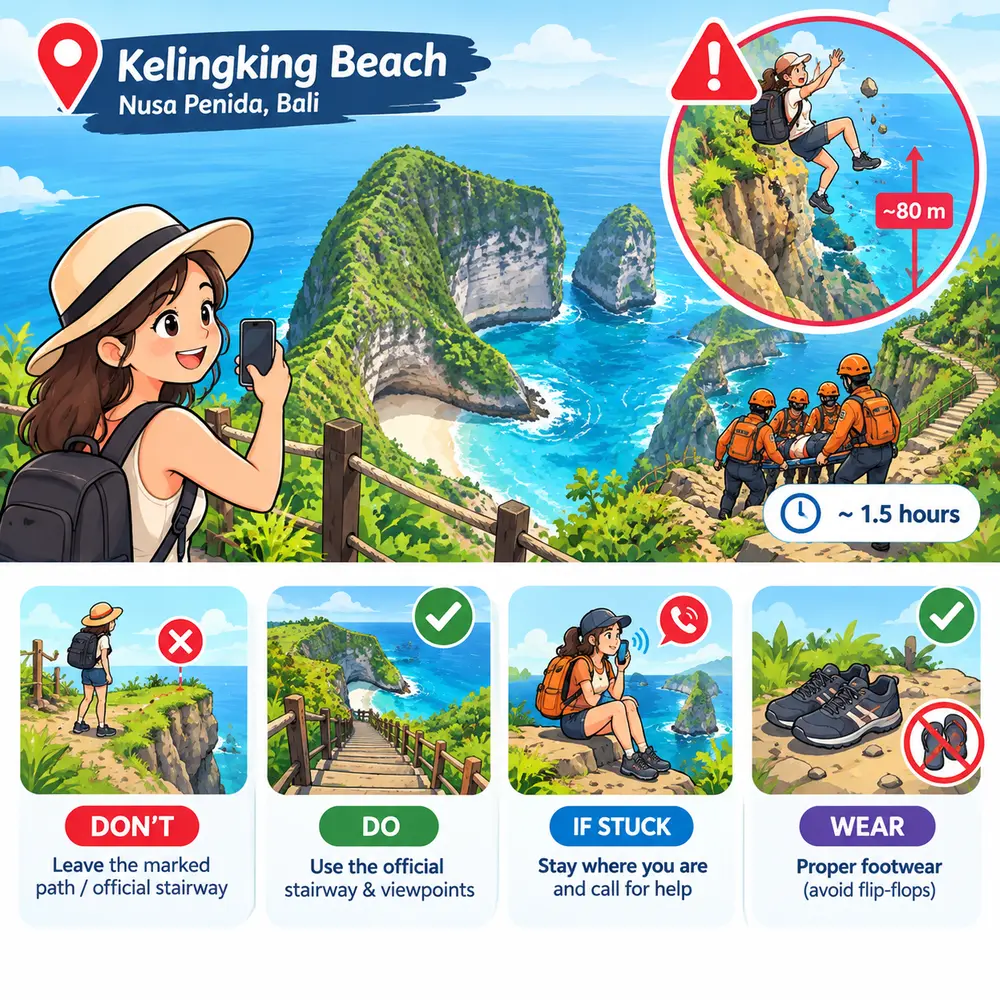
According to Cakra Negara, Coordinator of the Nusa Penida Alert Unit, another tourist first alerted lifeguard I Komang Wijaya Astika Putra that a foreign visitor appeared to be stuck on the cliffside. Rescuers confirmed the woman was stranded partway down the cliff face, on a path that did not actually lead to the beach below. Negara’s account was direct about what happened next: “the victim had attempted to find a way down on her own while stuck on the cliff before slipping and falling into the ravine.” She fell an estimated 80 meters onto rocky shoreline, sustaining multiple fractures. Rough seas ruled out a sea-based evacuation, forcing the rescue team to use the main Kelingking Beach stairway instead — a rescue that took roughly an hour and a half given how steep and unstable the terrain is.
Why Kelingking’s Cliffs Are Riskier Than They Look
Kelingking Beach’s cliffside viewpoint, roughly 180 meters above the water, is one of the most recognizable images of Bali-area tourism — it’s the shot that ends up on travel blogs and Instagram feeds constantly. That popularity is part of the problem: the official stairway down to the beach is steep but managed, while the surrounding cliff edges attract visitors looking for a better photo angle or a shortcut, often without any barrier, signage, or formal path at all. A route that looks walkable from a distance can dead-end on a ledge with no way down and no easy way back up, which appears to be close to what happened here.
How to Actually Stay Safe If You Visit
Stick to the official stairway and marked viewpoints, and treat any unofficial-looking trail along the cliff edge as a dead end rather than a shortcut, regardless of how solid the ground looks. If you do get stuck or disoriented on the cliffside, the safest move is to stay put and call for help rather than attempt to climb further down on your own — rescue teams have the equipment and experience to manage the terrain safely, and most falls happen during self-rescue attempts rather than the initial misstep. Good footwear matters more than it seems like it should; the path is loose, dry, and steep enough that flip-flops or worn soles measurably raise the risk.
Quick Answers About Kelingking Beach Safety
Is Kelingking Beach closed after this incident? No — the beach and its official stairway remain open to visitors; there’s no indication of a closure tied to this incident.
What should I do if I get stuck on the cliff edge? Stop moving, stay where you are, and call for help rather than attempting to find your own way down — that’s the point where most serious falls happen.
Is the official stairway itself dangerous? It’s steep but managed and marked; the real risk comes from leaving it for unofficial cliff-edge paths that don’t actually lead anywhere.
Are there other viewpoints nearby with the same risk? Yes — Nusa Penida’s coastline includes several other unguarded clifftop viewpoints near Broken Beach and Angel’s Billabong with similar drop-offs; the same rule applies at all of them: stick to the marked path.
The Chimera Villas Take
Nusa Penida day trips are a genuinely worthwhile addition to a Bali holiday, and stories like this shouldn’t be a reason to skip it — they’re a reason to treat the marked paths as non-negotiable rather than a suggestion. It’s the same logic behind how we think about safety information generally: not to make Bali sound riskier than it is, but to make sure a rare, serious outcome like this one gets flagged clearly rather than buried under postcard photos of the same cliff.