Bali Airport Is Expanding to 32 Million Passengers, and Adding a Water Taxi to Canggu
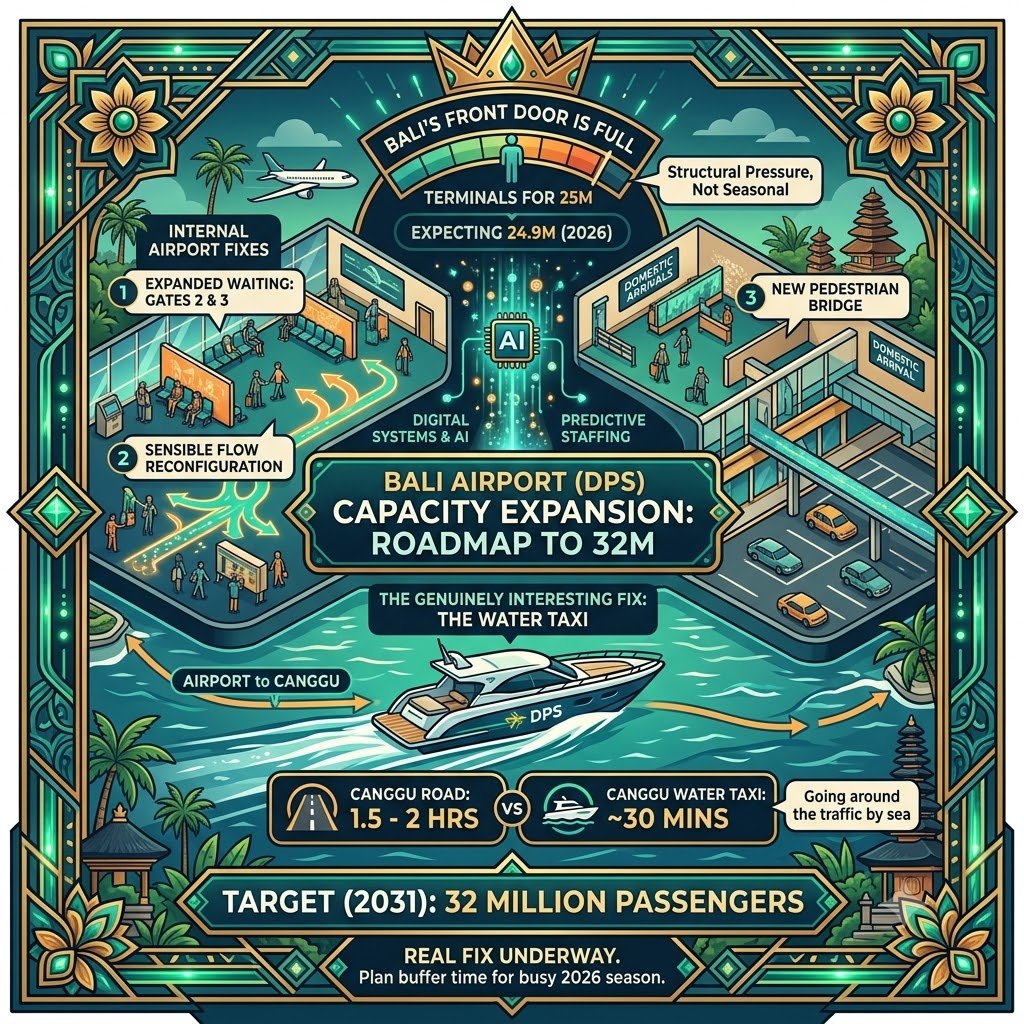
Here are two numbers that explain everything about Ngurah Rai International Airport right now. Its terminals are built to handle 25 million passengers a year. It expects to handle 24.9 million in 2026.
That’s a gap of about one hundred thousand people, on an airport serving nearly twenty-five million. In practical terms, Bali’s front door is full. Which is why the Ministry of Transportation and airport operator PT Angkasa Pura Indonesia are now working toward a target of 32 million passengers a year by 2031.
Short version: the queues you’ve noticed aren’t your imagination, they’re a capacity problem with a real fix underway, and one part of that fix is a boat.
What’s Actually Being Built
The plan is less about pouring new concrete than about untangling what’s already there. Passenger waiting areas are being expanded, particularly around international departure gates 2 and 3. The domestic and international terminal layouts are being reconfigured so people flow through more sensibly instead of crossing each other’s paths. A new pedestrian bridge will connect domestic arrivals directly to the parking area.
Alongside the physical work, the airport is moving to digital operational systems using AI and data-driven management, which in airport language usually means better prediction of where the crush is about to happen and staffing for it before it does.
Transportation Minister Dudy Purwagandhi put the goal plainly: “Through airport capacity expansion, we hope this number can increase to around 32 million passengers.”
The Water Taxi Is the Genuinely Interesting Bit
Buried in the plans is a proposed water taxi service running from the airport to Canggu. The projected journey time is around 30 minutes, against the 1.5 to 2 hours the same trip currently takes by road at the wrong time of day.
Anyone who has sat in the Kerobokan crawl with a suitcase and a slowly evaporating will to live understands why this matters. It’s also a quietly clever answer to a problem that road-widening alone was never going to solve, because the land simply isn’t there. Going around the traffic by sea is the kind of idea that sounds eccentric until you look at a map.
What This Means for Your Arrival
Realistically, not much this year. Terminal reconfiguration is slow, unglamorous work, and the 32 million target is set for 2031. If you’re flying in this season you should still plan for a busy airport, particularly during the afternoon arrival banks.
But the direction matters. It signals that the pressure Bali has felt through this record-breaking travel season is being treated as a structural issue rather than a seasonal one, and it sits alongside the broader road and transfer improvements already in motion. It’s also not the only airport story on the island right now, with a second airport for North Bali gathering serious momentum.
Quick Answers About the Ngurah Rai Expansion
What’s the current capacity? About 25 million passengers a year, with 24.9 million expected in 2026.
What’s the target? 32 million passengers annually by 2031.
What’s the water taxi? A proposed airport-to-Canggu boat service with a projected 30-minute journey time, versus 1.5 to 2 hours by road.
Will it affect my trip this year? Probably not much. Expect a busy airport in 2026 and plan arrival transfers with buffer time.
The Chimera Villas Take
None of this changes what you should do on arrival day this season: build in more time than feels necessary, and don’t schedule anything tight for the evening you land. The good news is that Seminyak is one of the closer runs from the airport, so you’re on the right side of the traffic maths either way. Tell us your flight number and we’ll time your transfer around the actual arrival, not the scheduled one.